 |
|
Archaeological Sites
It’s tempting to pick up a bone or
clay pot found at a site as a souvenir. However, not
only is it illegal to remove antiquities, but you may
be depriving local archaeologists of important
evidence. Most of the area has, at the very least,
been extensively surveyed and is only waiting for
funding to begin excavation. If you do find something,
the best thing to do is to leave it alone and notify
the Tourist Office. Excavation sites are like crime
scenes: often the location and position of an object
give valuable information about the site, making the
context of the object just as important as the object
itself.
|
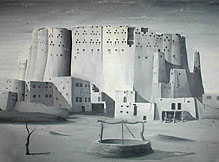
A painting of ancient Shali
|
|
Welcome to Siwa
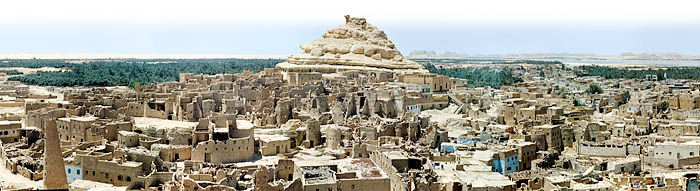
Jebel El Mawta (“Mountain of the Dead”)
Over 700 rock tombs are carved into this limestone
hill, only a fraction of which have been excavated. Looming
less than a kilometer north of the marketplace, in ancient
times it would have been the main necropolis for the oasis
with tombs dating to the Late Egyptian and Greco Roman
periods. More recently, its tombs were used by Siwans as bomb
shelters during World War II. Soldiers stationed in the oasis
during the war also used the tombs, and according to Ahmed
Fakhry not only left their graffiti but made off with bits of
some of the best paintings. Of the excavated tombs, four
remain relatively intact:
The Tomb of Si-Amun
Not much is known about Si-Amun, who would have been
buried in this beautifully painted tomb. From the tomb’s
paintings he appears to have been of Greek descent, having
curly black hair, a beard and moustache and fair skin, and to
have married an Egyptian. In the scenes that cover the
tomb’s western wall, he is variously shown seated in a
chair, in judgment before the god Osiris, and swaddled in the
bandages of a mummy. The eastern wall portrays Si-Amun
worshipping the gods Amun and Osiris. Look for Si-Amun’s
oldest son, cloaked in panther skins, and for the red
gridlines left by the tomb’s artist. On the ceiling, the
goddess Nut reaches across an inky sea of stars and solar
boats. Rows of vultures and falcons rim another section of the
ceiling.
The Tomb of Misu-Isis
The interior of this tomb was never finished. Above
the door of the burial chamber are bas relief cobras bearing
sun disks; the gods Osiris and Isis frame the doorway.
The Tomb of Ni-per-pa-thoth
Ni-per-pa-thoth means “The one who belongs to the House
of Thoth.” The owner of this 26th Dynasty tomb
also bore the title “Prophet of Osiris and Scribe of the
Divine Books,” and it is Osiris that we see him worshipping
throughout the tomb. In a scene from daily life, he is shown
leading four cows. The burial chamber branches off into a
series of small halls or chambers
The Tomb of the Crocodile
This tomb is named for the yellow crocodile painted on
one of its entrance walls. At the back of the tomb are also
paintings of blue and yellow foxes. In the painting showing
the god Thoth writing, note the live bird tied to the stem of
the table.
.

Juba Bath (Cleopatra Bath)
Another favourite bathing spot for locals and
tourists is Fatnas Island, located on the salt
lake of Birket Siwa, surrounded by palm trees and
beautiful scenery.
|
|







 Contact
Us
Contact
Us